

BridgeIT
Designing a trusted, human centered, design led enterprise AI experience for employees
Worked from 2024 to early 2025BridgeIT Launched on January 2024, CircuIT Launched on June 2025

What is BridgeIT?
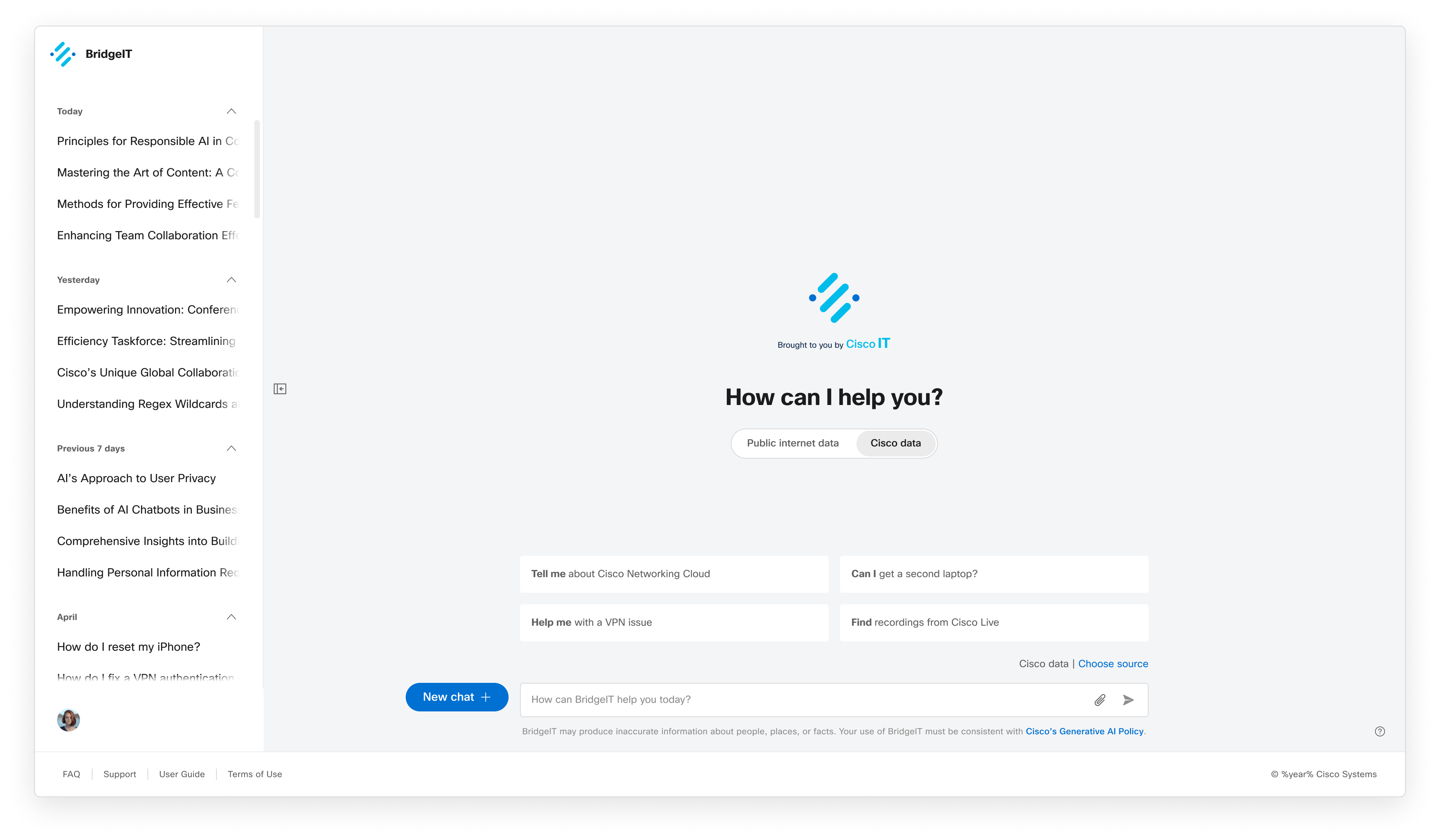
BridgeIT was originally launched as Cisco’s enterprise AI assistant, specifically designed to empower employees to work smarter, faster, and more confidently while operating within the company’s strict security, privacy, and compliance standards. At its inception, BridgeIT served as a safe internal alternative to public generative AI tools, ensuring that proprietary data remained protected. It quickly evolved from a simple interface into a design-led AI platform that integrates Cisco’s vast internal knowledge, systems, and complex workflows into a single, trusted assistant.
Rather than acting as just another instance of ChatGPT, BridgeIT was carefully positioned as a knowledgeable Cisco colleague that understands internal context, respects critical data boundaries, and supports employees directly within the flow of their daily work. This foundation of trust and deep integration eventually led to its strategic rebranding. Today, the platform continues its mission under the new name CircuIT, representing the next evolution of Cisco’s commitment to seamless, AI-driven productivity.
My Role: Lead Designer
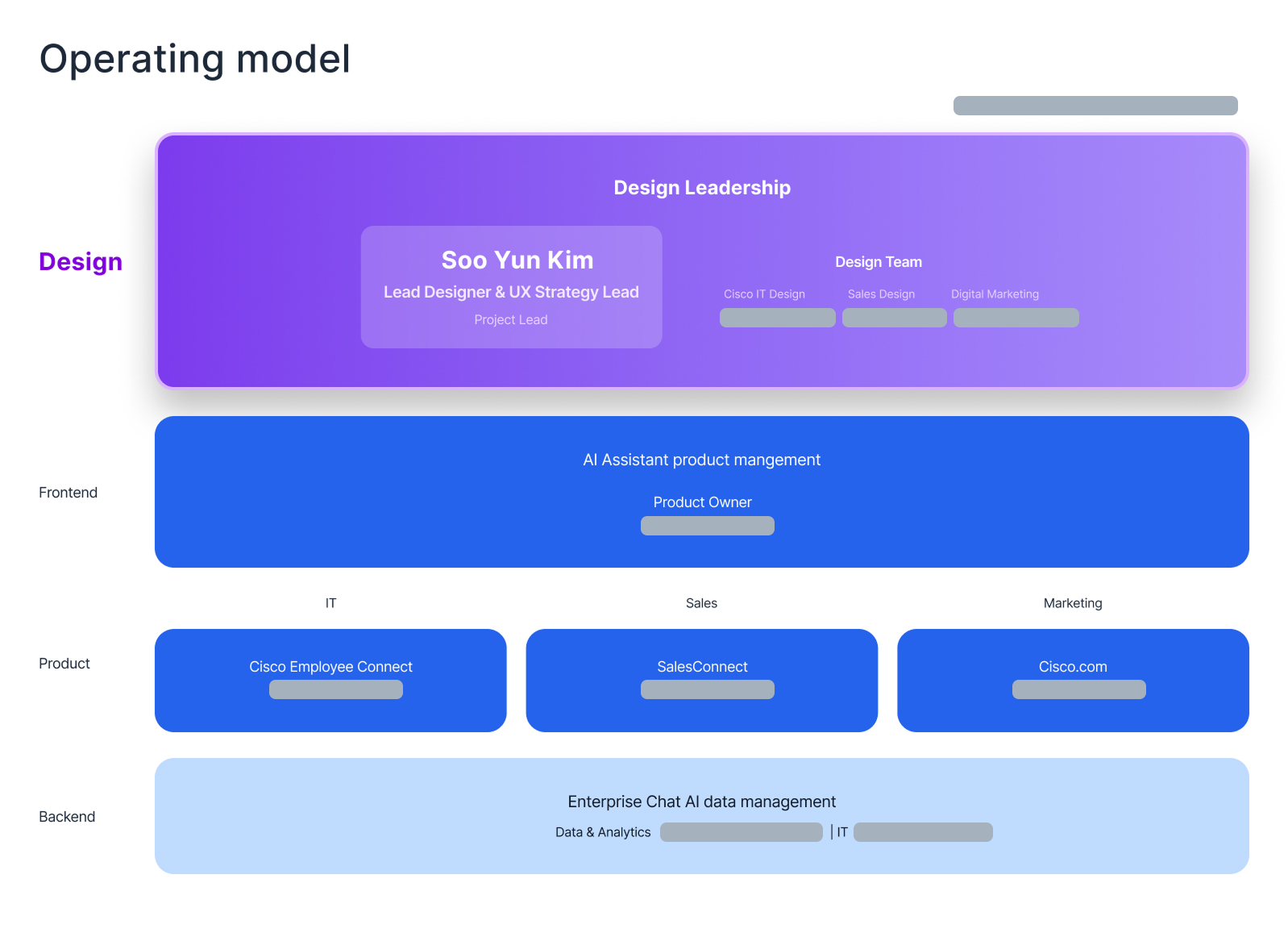
I served as Principal Designer and Design Lead for BridgeIT, owning the end-to-end UX strategy.
My responsibilities included:
- Defining the product vision for BridgeIT as the AI assistant for Cisco employees
- Leading UX strategy across web, Webex, and future in-flow experiences
- Partnering closely with UX Research, Content Design, Engineering, Data, Legal, and Security
- Translating highly technical AI constraints into clear, usable, human-centered experiences
- Establishing design principles for trust, safety, and usability in GenAI products
- Shaping BridgeIT’s voice, tone, and character—approachable, knowledgeable, but never pretending to be human
- Using research and adoption data to prioritize features, defaults, and roadmap decisions
In practice, I acted as a bridge between design, engineering, and business, ensuring that complex AI systems felt intuitive, safe, and genuinely helpful to everyday employees.
The Challenge
BridgeIT Initial Design
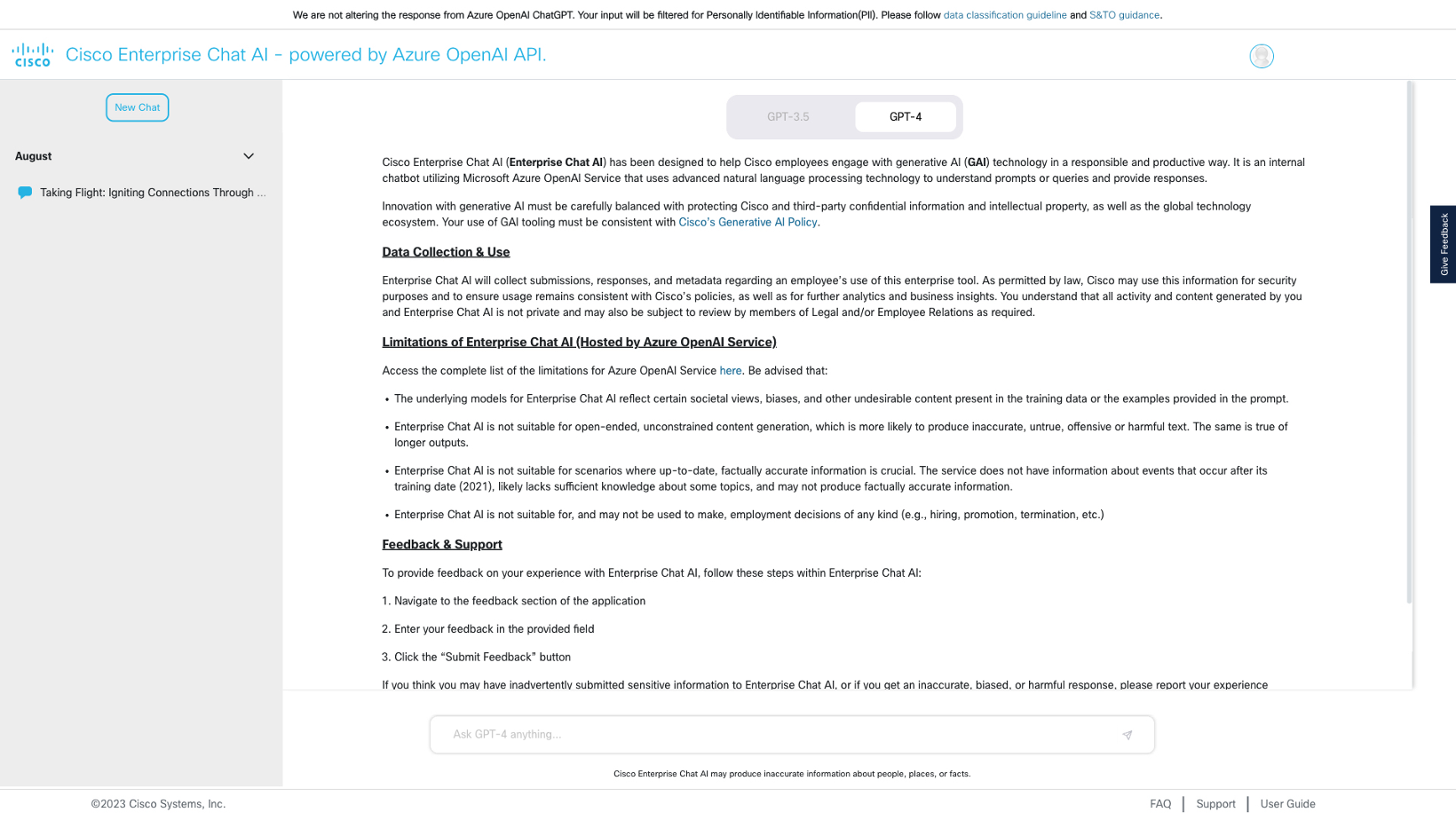
This was the initial BridgeIT design, which did not follow Cisco’s Atmosphere design system and showed clear inconsistencies across the experience. Because the design was primarily owned by the development team, it lacked strong design alignment and consistency.

Usability issues
With only 31 percent adoption, users reported difficulty both in finding the tool and in using it effectively. In addition, the lack of Cisco data significantly limited its usefulness.

Technical constraints
The system was unable to merge multiple data sources, and it was unclear which teams were working with which vendors. At the same time, the project faced competition from other initiatives and very high expectations for success.

Size of the team
The core design and development team consisted of 15 people, most of whom were not allocated to the project at full capacity. Only a small portion of the team was well versed in AI.
Other challeges
Safety, ethics, and trust at enterprise scale
Unlike consumer AI tools, BridgeIT had to operate within:
- Strict data permissions and access controls
- PII, HR, legal, and restricted data policies
- Regional regulations and evolving AI governance
At the same time, users needed to feel safe, not just be told they were safe.
Designing new mental models for GenAI at work
Employees brought expectations from tools like ChatGPT, but BridgeIT worked differently:
- Internal vs. public data could not be mixed
- Not all sources were available to every user
- AI capabilities had to be learned through use, not documentation
The challenge was to help users learn while working, without overwhelming them.
Process
Define the BridgeIT vision
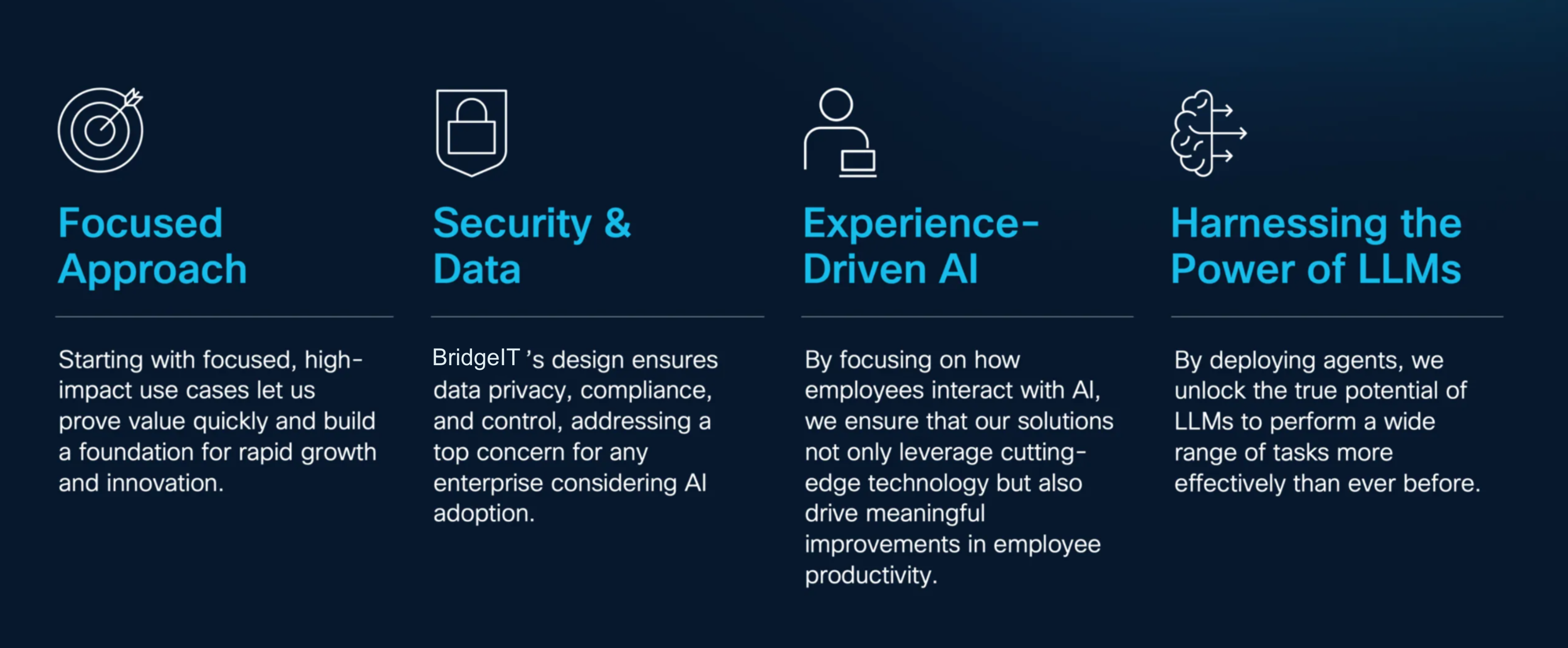
- I defined BridgeIT as a single, unified AI assistant for employees, focused on high priority IT tasks and real workflows. The goal was not to add AI broadly, but to design clear user flows and conversation patterns where AI could meaningfully assist.
- BridgeIT was intentionally designed, not just built. Design led the AI experience by shaping defaults, interaction patterns, and trust through use, not explanation.
- This work was grounded in user research, usability testing, and continuous feedback, ensuring the experience aligned with real employee needs and scaled with quality.
Build a central roadmap
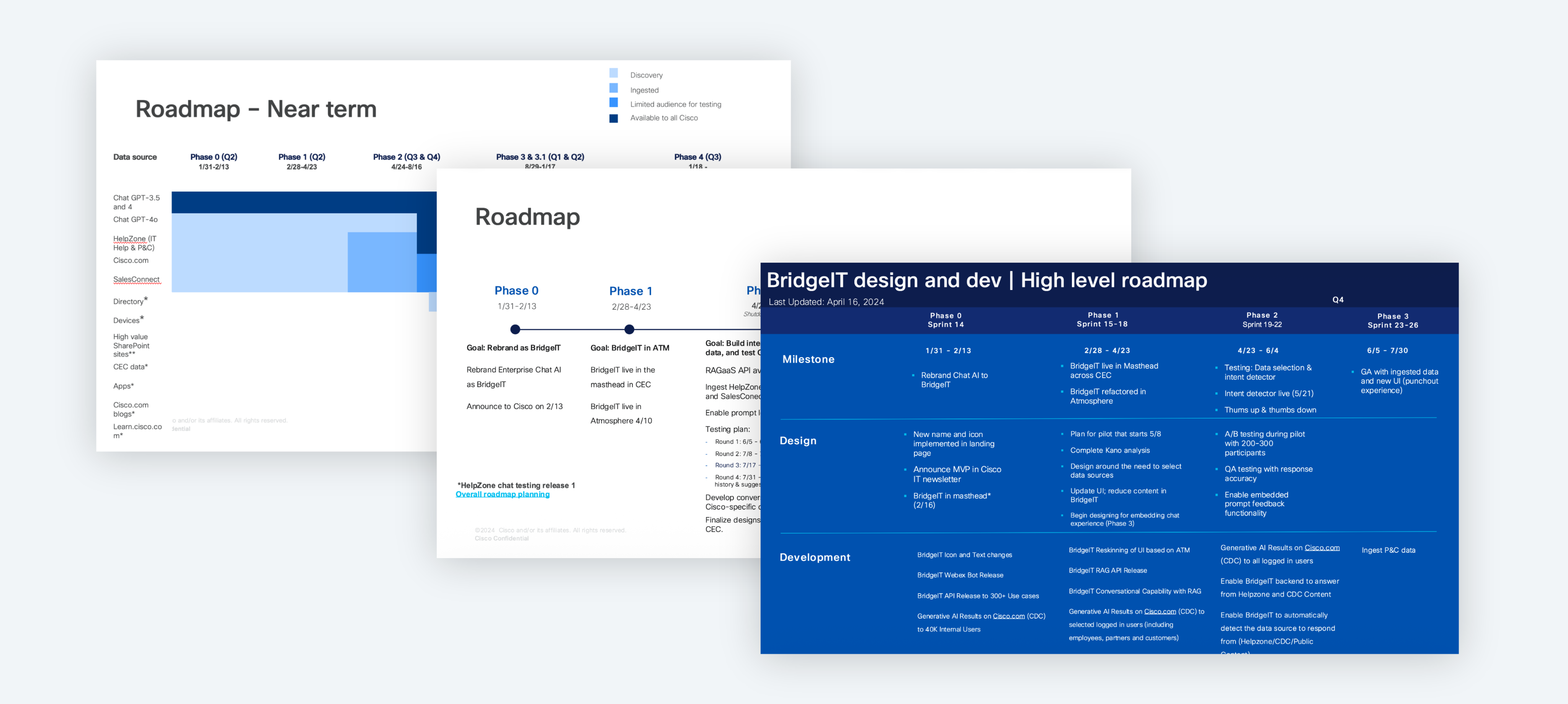
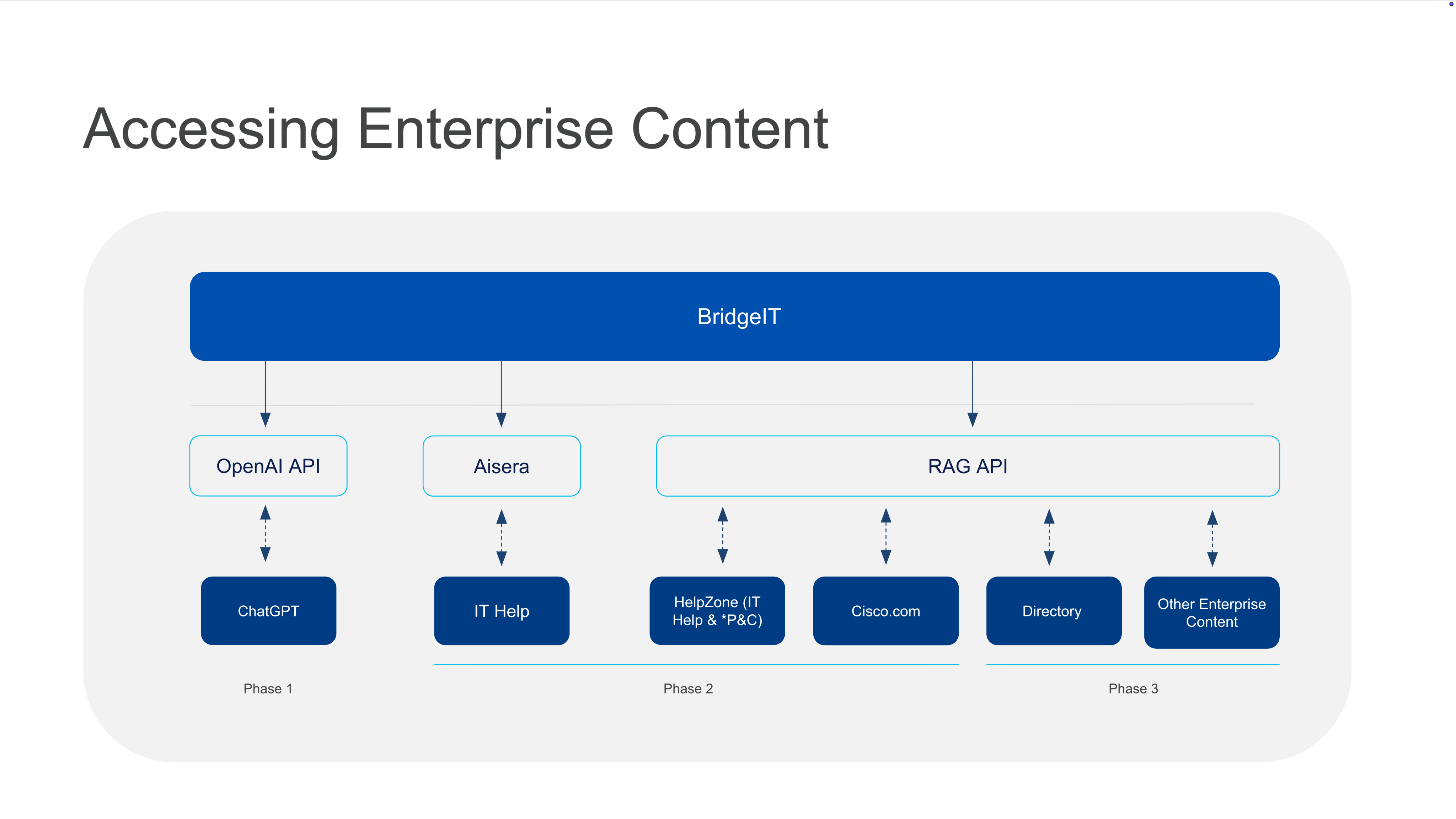
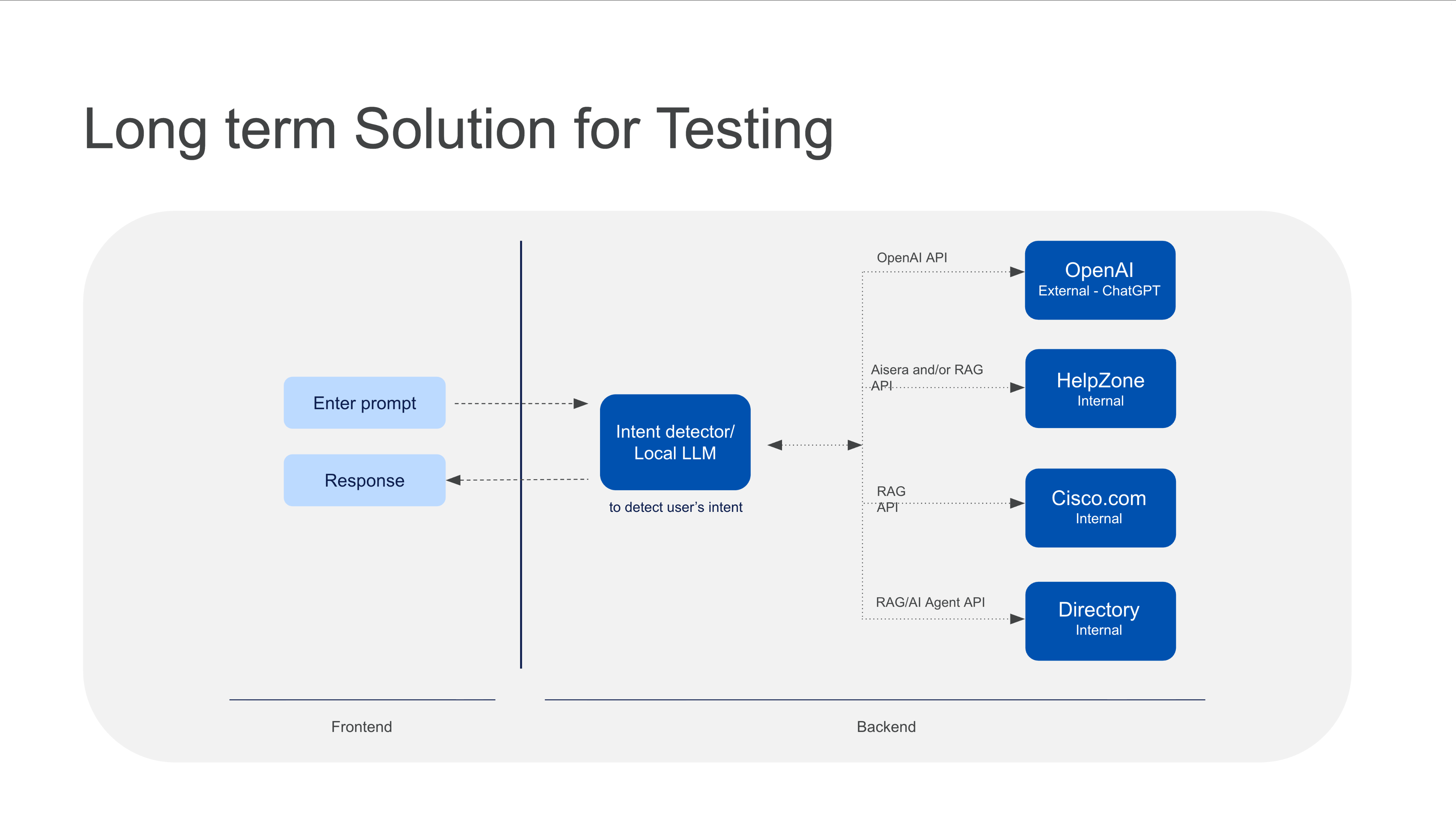
I defined a clear roadmap with well scoped phases, outlining what could be delivered at each stage. I prioritized high impact, high feasibility internal data as initial test cases to validate value early.
Research Strategy
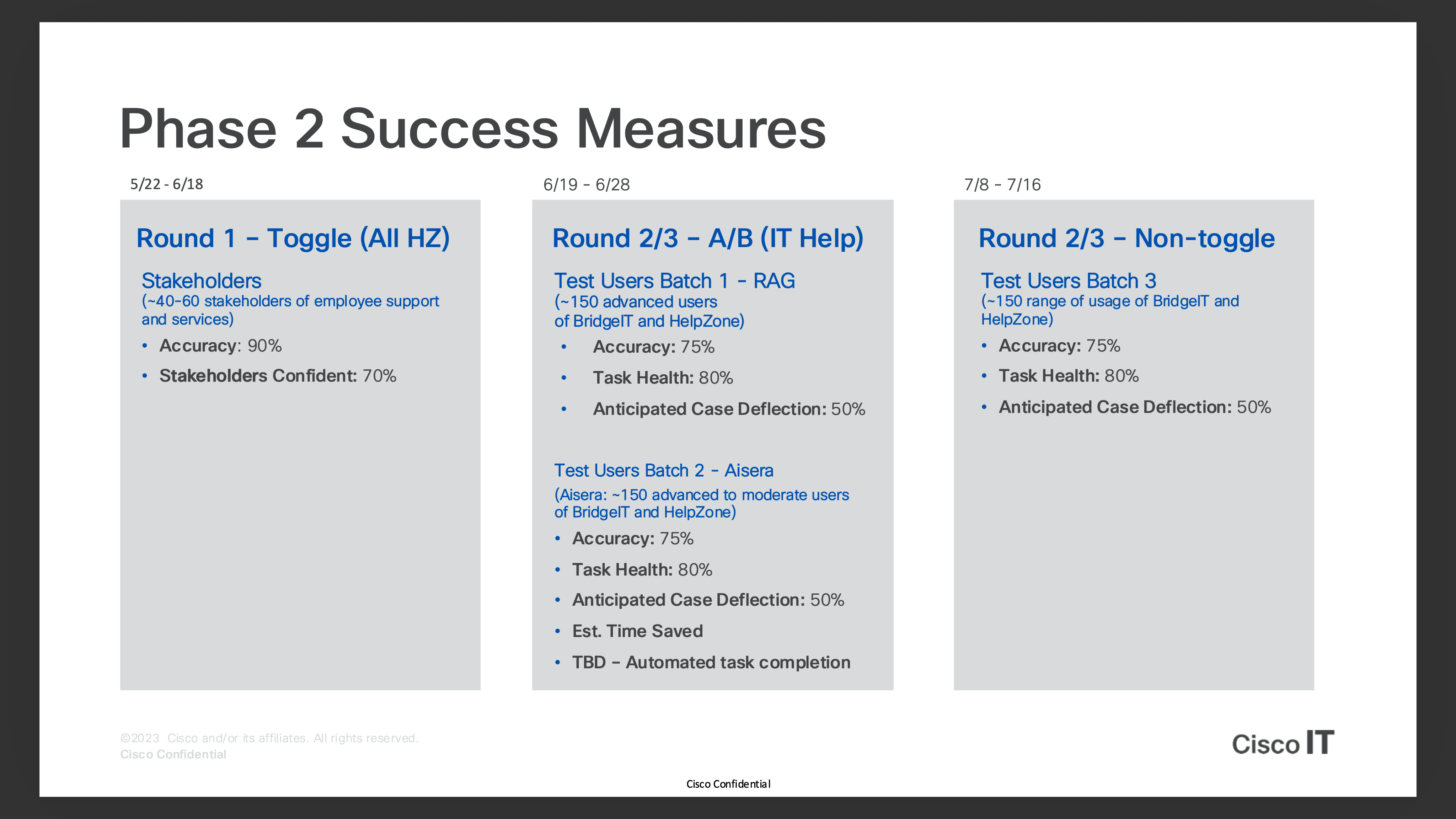
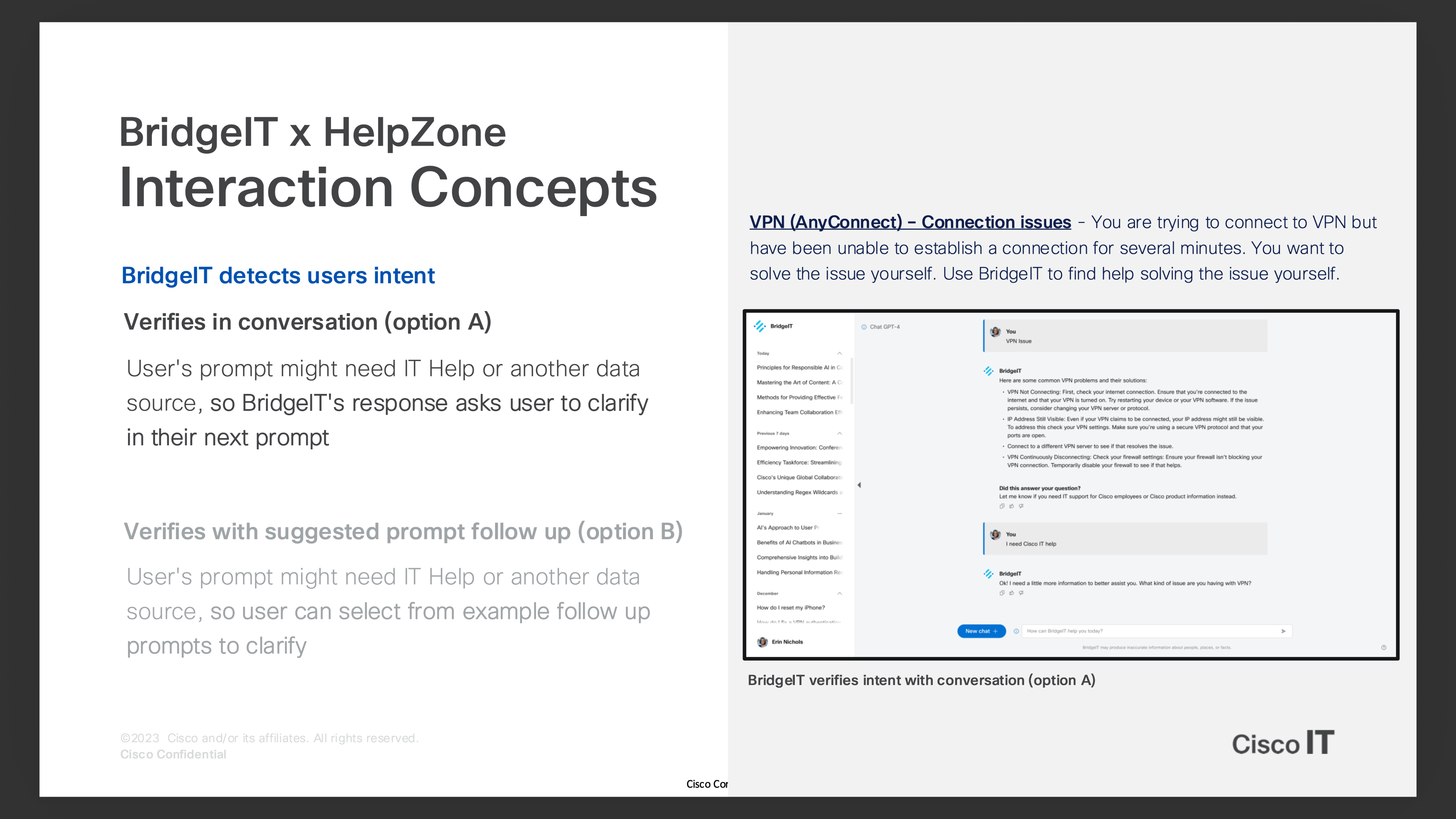
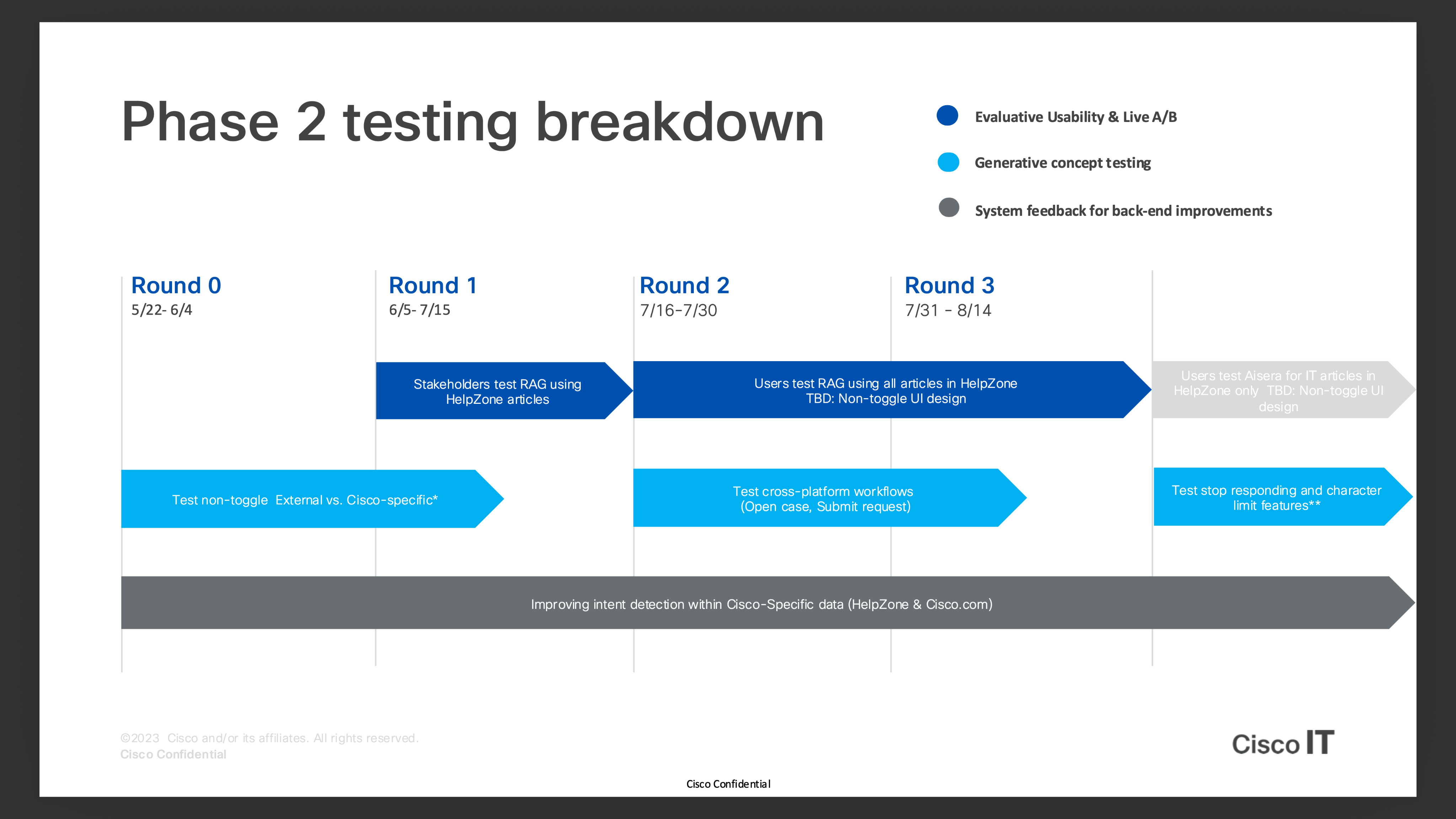
I worked closely with dedicated team of UX researchers through a comprehensive, multi-phase roadmap, personally overseeing the planning, execution, and observation of user interviews to transform product insights into a context-aware AI platform.
- Strategic Roadmap: Orchestrated four rounds of evaluative and generative testing, Phase 0 through Phase 3, to validate enterprise utility.
- Guided Execution: Led a research team in conducting "think-aloud" protocols and usability sessions with over 300 participants and 60 stakeholders.
- Observational Insights: Directed and observed user interviews to identify critical pain points and refine the AI's conversational flow.
- Data Prioritization: Managed Kano analysis and A/B testing to identify IT HelpZone and Cisco product knowledge as "table stakes".
- Business Impact: Validated a 90% accuracy rate and projected a 50% reduction in support case volume via self-help scenarios.
- UX Innovation: Directed the development of an "Intent Detector" to ensure the assistant integrated seamlessly into daily workflows.
Solution planning
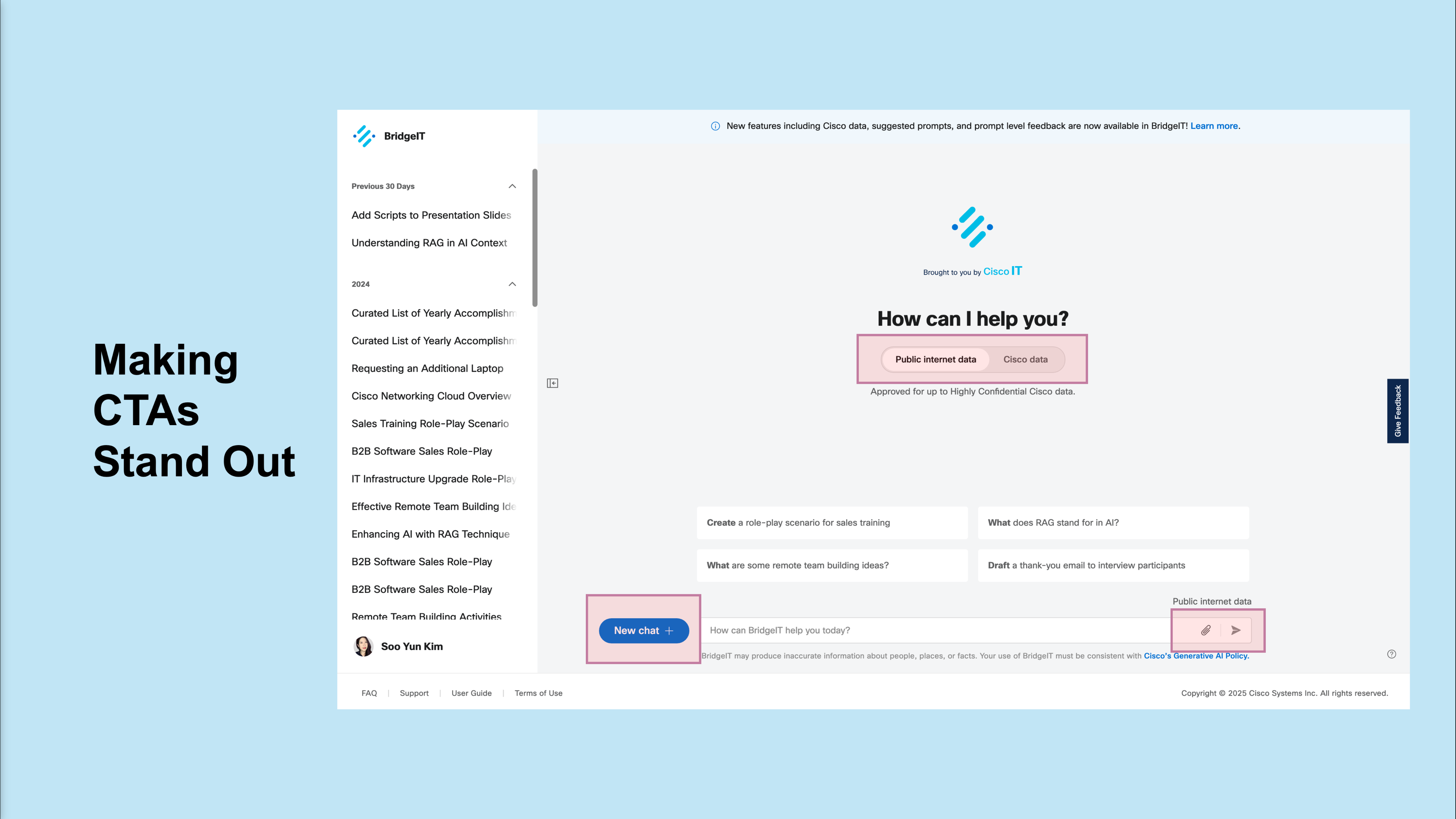
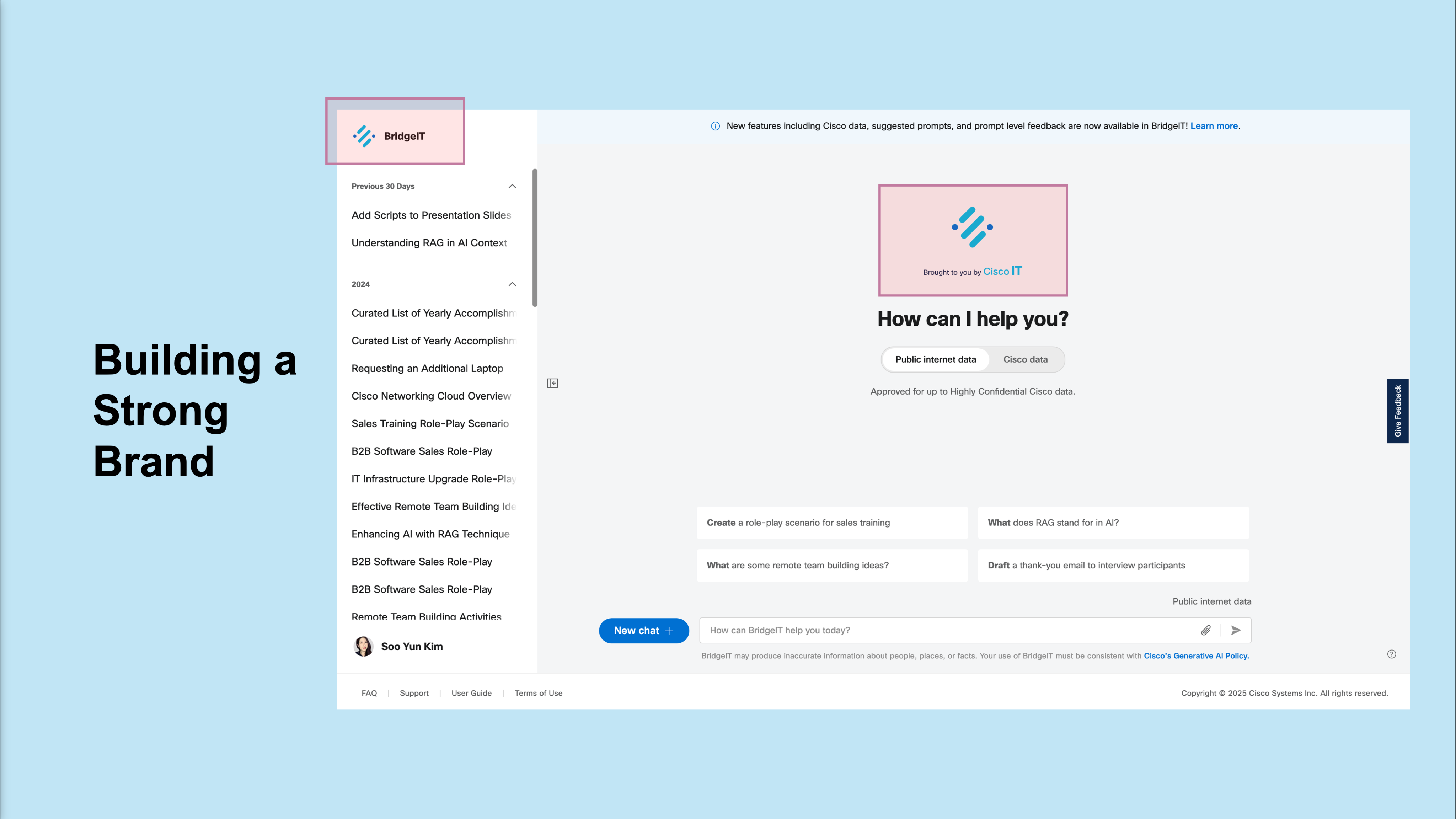
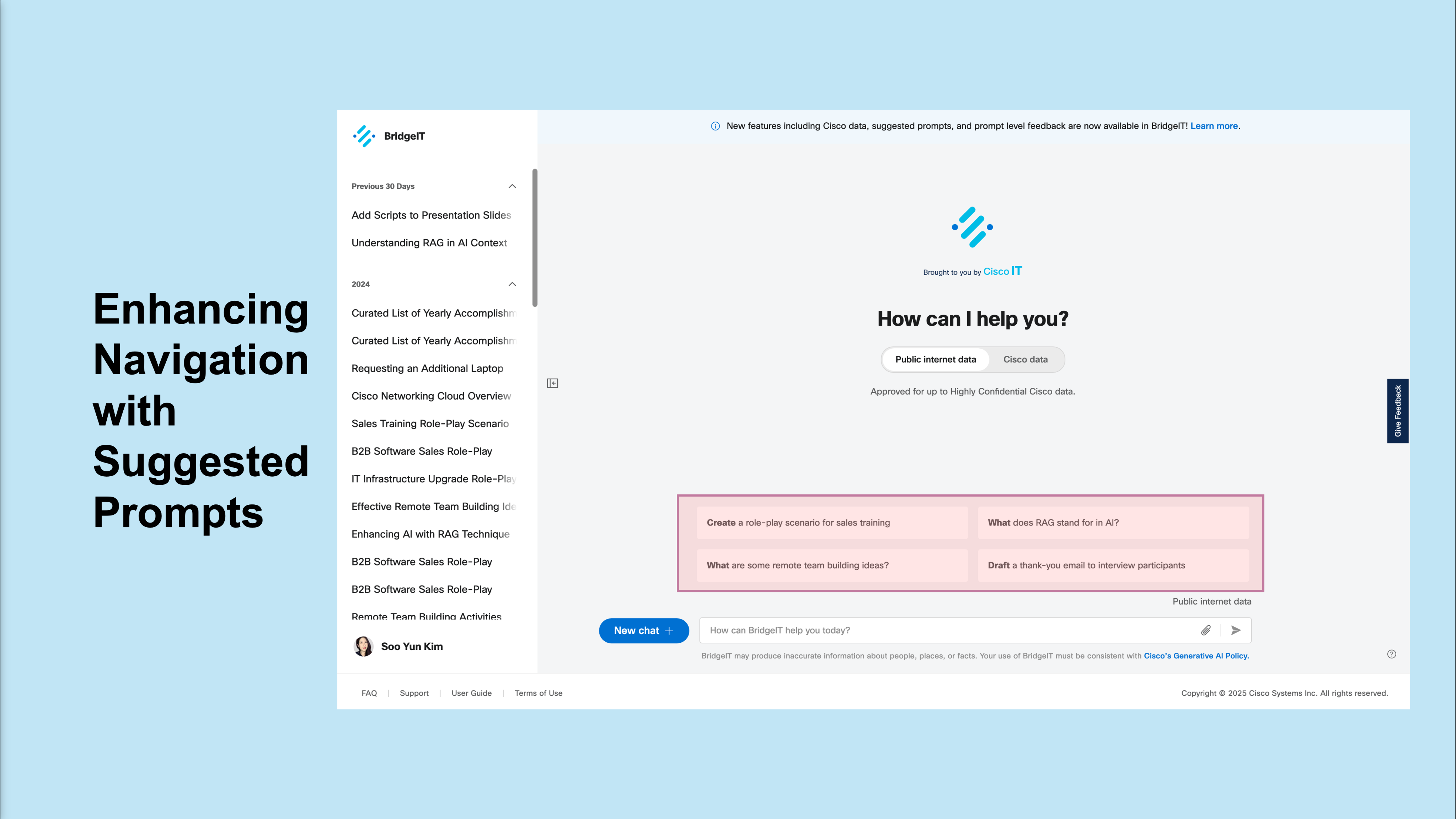
Applying Cisco Internal Design System
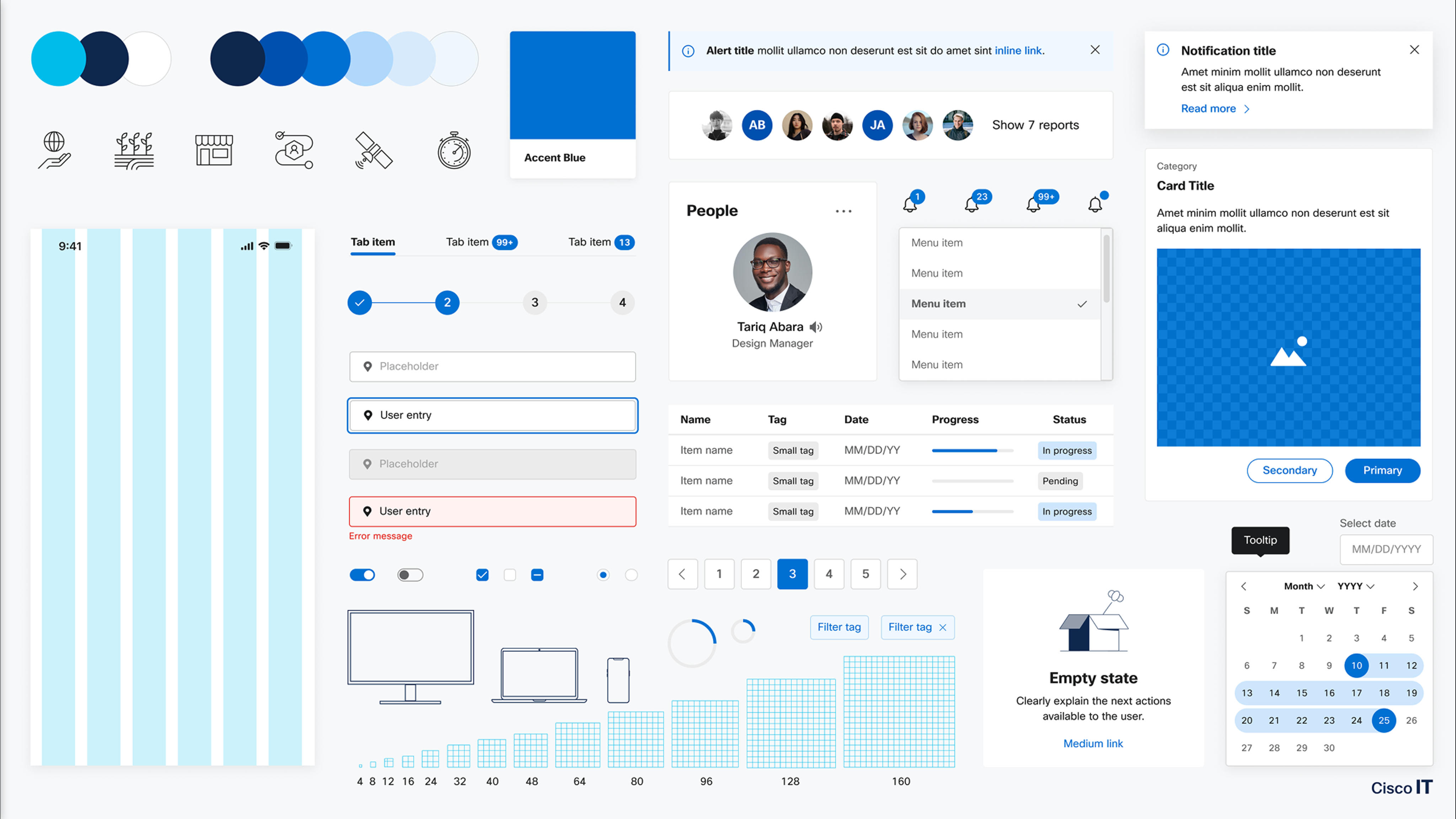
I applied Cisco’s internal design system to rebrand BridgeIT, creating a familiar and trusted experience for users. By using consistent colors, typography, and components, I helped users feel comfortable and confident when using the tool.
Darkmode Implementation
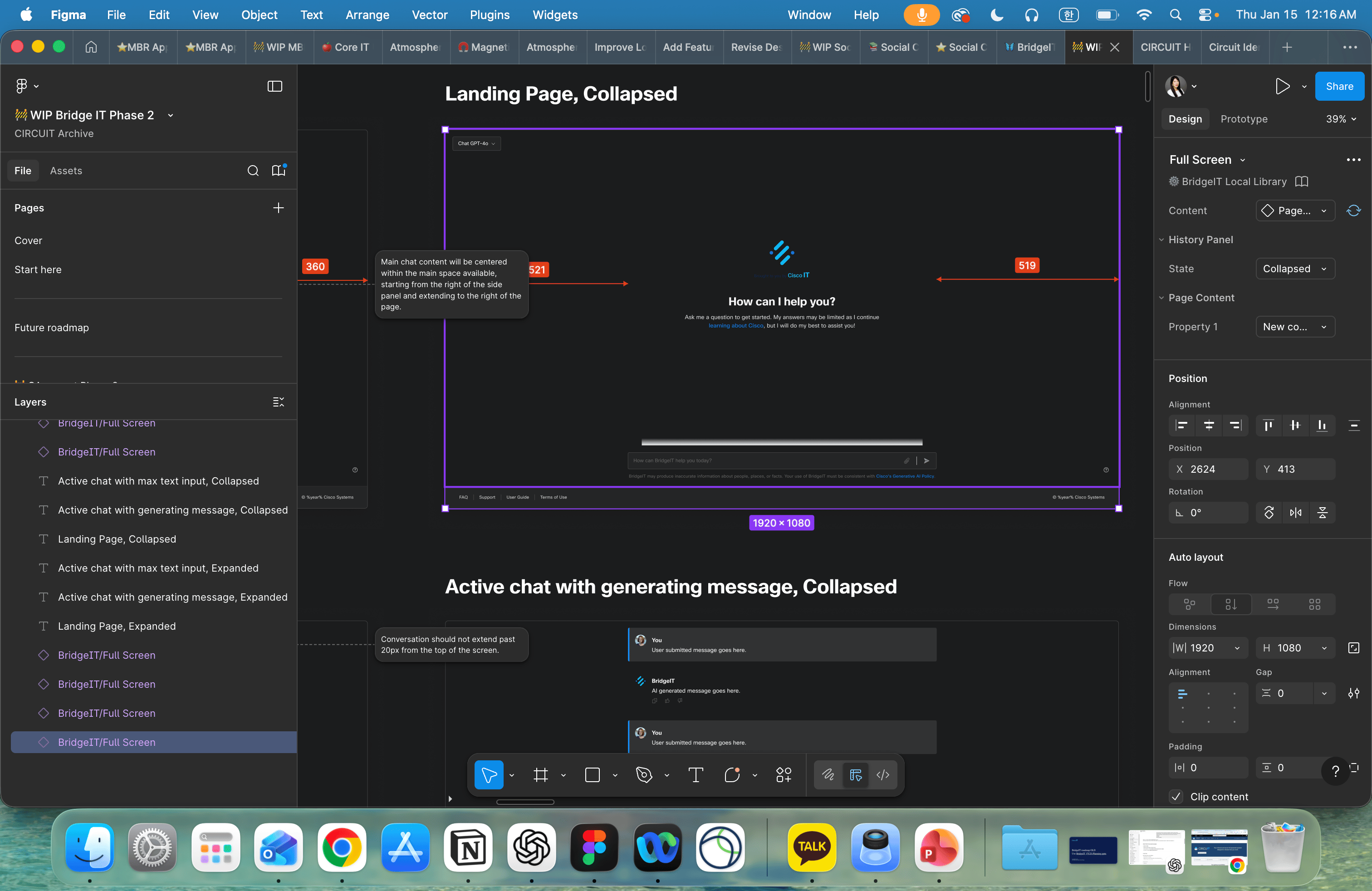
I applied dark mode and delivered production ready designs to the dev team, working closely with QA to resolve UI defects and ensure a polished, consistent experience.
Why This Work Matters
BridgeIT is not just an AI product. It is an organizational change effort. This work demonstrates how design can lead deeply technical initiatives and how AI can be human centered without trying to appear human. It also shows that enterprise AI succeeds only when trust, clarity, and usability come first.
This project reflects how I approach complex systems by making the invisible understandable and the complicated feel simple.
Visual Design Execution
Phase 0 - Before & After
Before
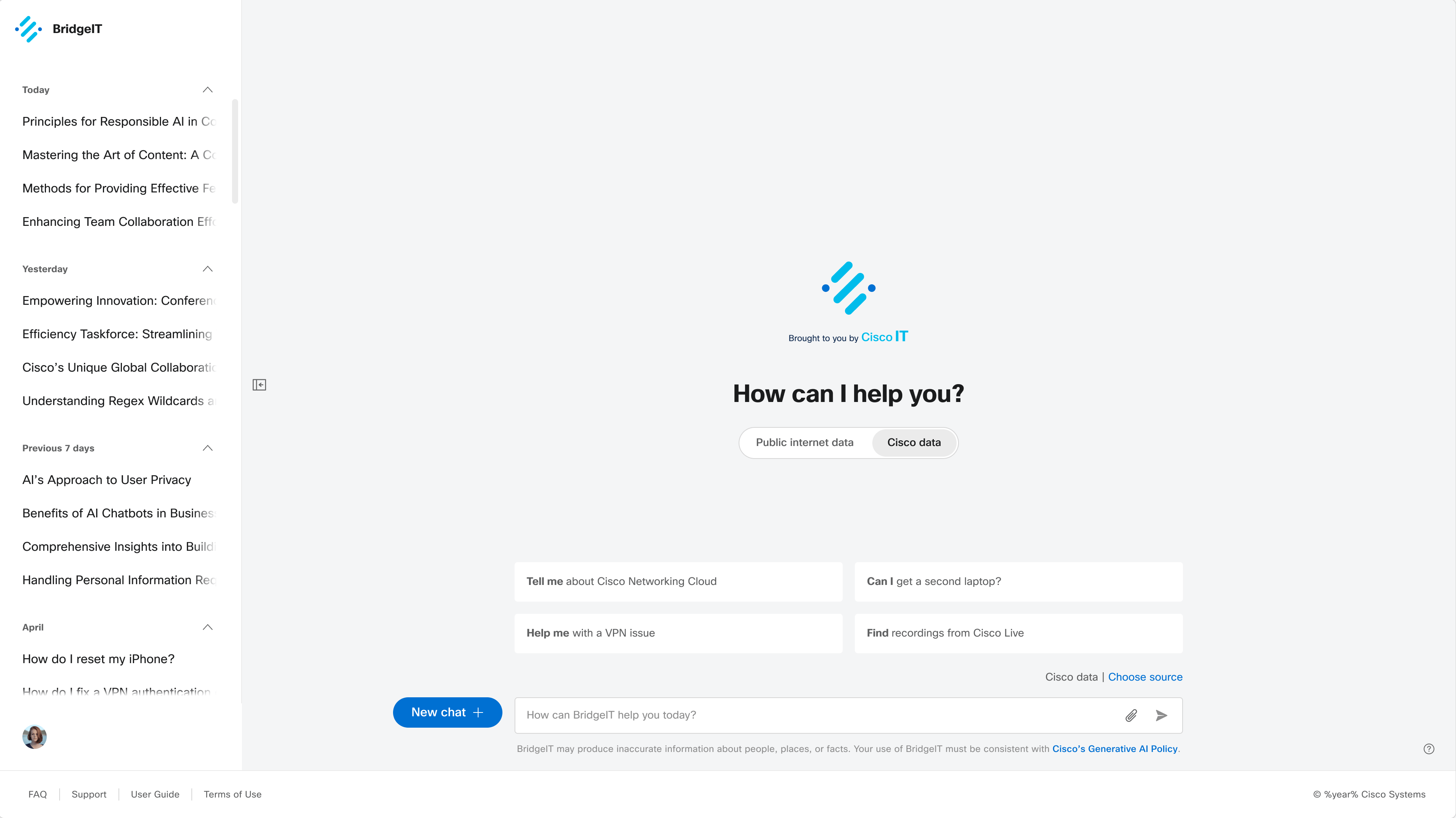
After
Phase 1 & Phase 2
Phase 3: New Branding Identity from BridgeIT to CircuIT
Product Impact & Result
92K+
Users in Cisco
~96K+
Total interactions since launch
73%
Users report CircuIT increases productivity
5hrs
Average time saved per week by Cisco workforce
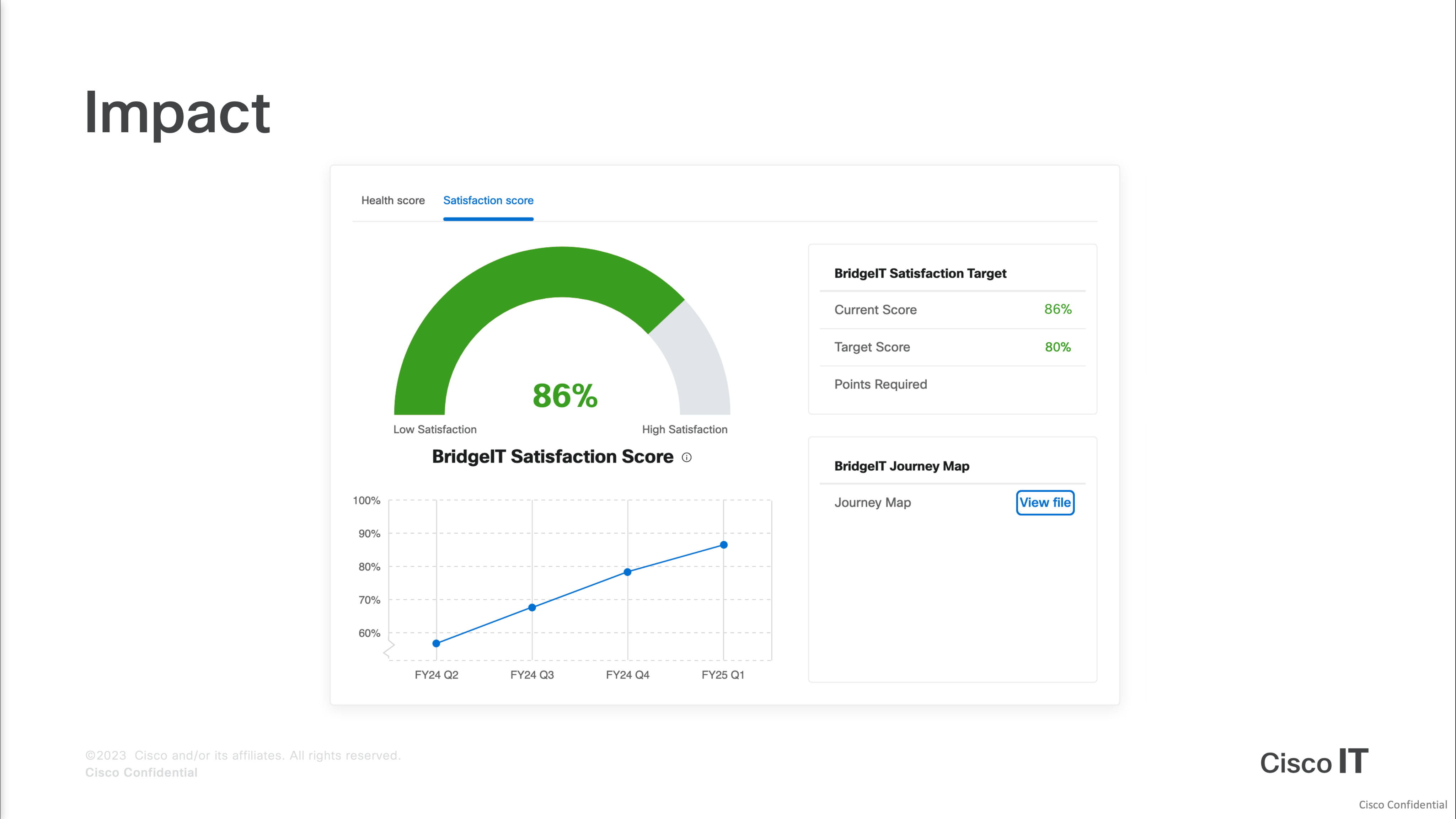
Executive Visibility and Adoption
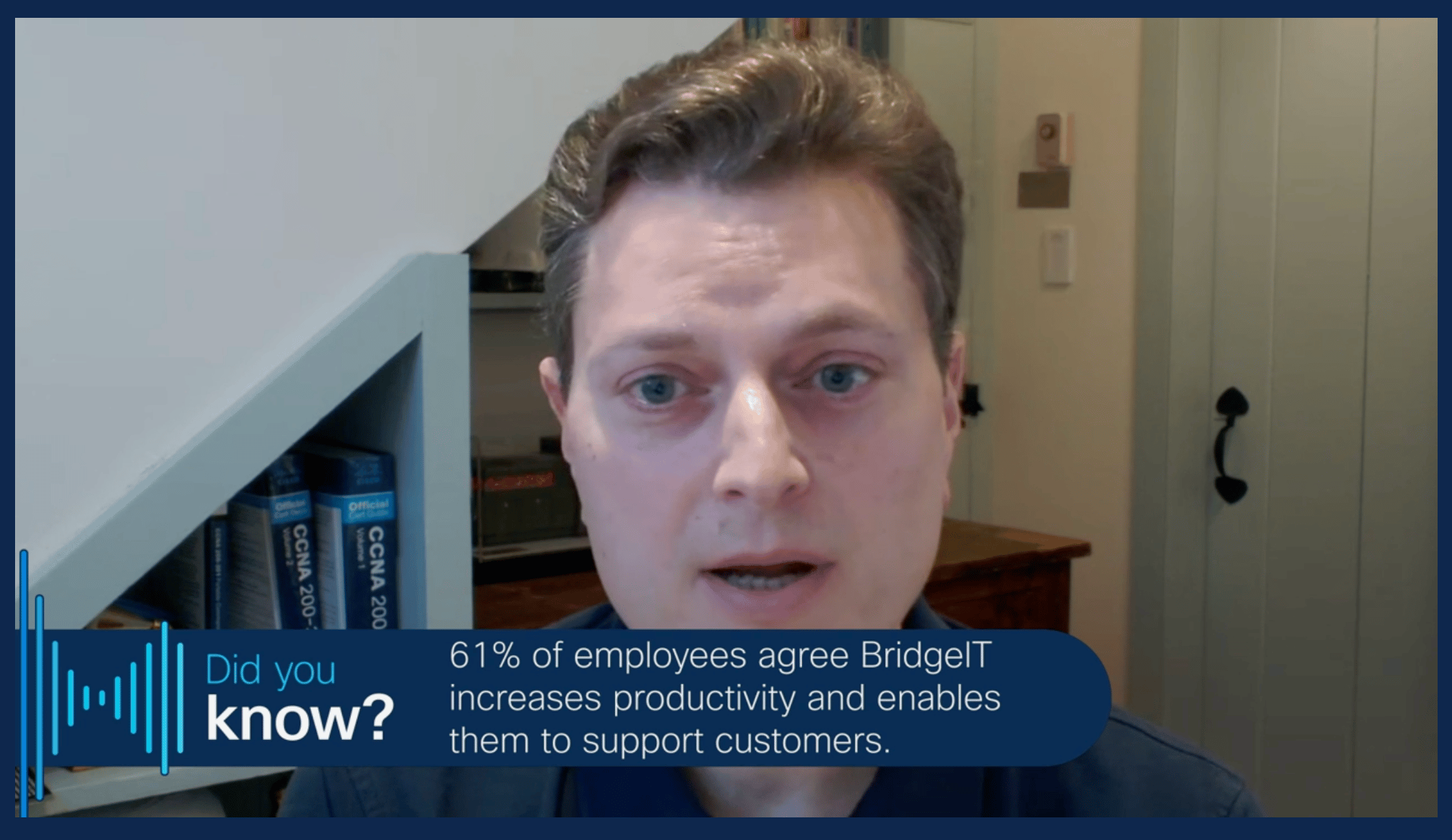
BridgeIT was showcased at Cisco Beat by Fletcher Previn, SVP and CIO of Cisco, highlighting real employee adoption and productivity impact. Usage data demonstrated how employees were already using BridgeIT for high value tasks such as content creation, product research, and technical problem solving, reinforcing the importance of a trusted, design led enterprise AI experience.
Through a design-led approach, BridgeIT evolved from a developer-owned chat tool into a trusted, enterprise-grade AI assistant that:
- Increased usability and approachability for non-technical users
- Established a clear, consistent mental model for AI at Cisco
- Built confidence around safety, privacy, and data boundaries
- Created a scalable foundation for future capabilities such as:
- File upload and RAG
- Agent frameworks
- Workflow automation
- AI-assisted IT task completion
BridgeIT continues to evolve, but its foundation is rooted in a simple idea:
when AI feels easy, safe, and useful, people will actually use it.


sooyundesign@gmail.com



© Soo Yun Kim 2026 All Rights Reserved
BridgeIT
Designing a trusted, human centered, design led enterprise AI experience for employees
Worked from 2024 to early 2025BridgeIT Launched on January 2024, CircuIT Launched on June 2025
What is BridgeIT?
BridgeIT was originally launched as Cisco’s enterprise AI assistant, specifically designed to empower employees to work smarter, faster, and more confidently while operating within the company’s strict security, privacy, and compliance standards. At its inception, BridgeIT served as a safe internal alternative to public generative AI tools, ensuring that proprietary data remained protected. It quickly evolved from a simple interface into a design-led AI platform that integrates Cisco’s vast internal knowledge, systems, and complex workflows into a single, trusted assistant.
Rather than acting as just another instance of ChatGPT, BridgeIT was carefully positioned as a knowledgeable Cisco colleague that understands internal context, respects critical data boundaries, and supports employees directly within the flow of their daily work. This foundation of trust and deep integration eventually led to its strategic rebranding. Today, the platform continues its mission under the new name CircuIT, representing the next evolution of Cisco’s commitment to seamless, AI-driven productivity.
My Role: Lead Designer
I served as Principal Designer and Design Lead for BridgeIT, owning the end-to-end UX strategy.
My responsibilities included:
- Defining the product vision for BridgeIT as the AI assistant for Cisco employees
- Leading UX strategy across web, Webex, and future in-flow experiences
- Partnering closely with UX Research, Content Design, Engineering, Data, Legal, and Security
- Translating highly technical AI constraints into clear, usable, human-centered experiences
- Establishing design principles for trust, safety, and usability in GenAI products
- Shaping BridgeIT’s voice, tone, and character—approachable, knowledgeable, but never pretending to be human
- Using research and adoption data to prioritize features, defaults, and roadmap decisions
In practice, I acted as a bridge between design, engineering, and business, ensuring that complex AI systems felt intuitive, safe, and genuinely helpful to everyday employees.
The Challenge
BridgeIT Initial Design
This was the initial BridgeIT design, which did not follow Cisco’s Atmosphere design system and showed clear inconsistencies across the experience. Because the design was primarily owned by the development team, it lacked strong design alignment and consistency.
Usability issues
With only 31 percent adoption, users reported difficulty both in finding the tool and in using it effectively. In addition, the lack of Cisco data significantly limited its usefulness.
Technical constraints
The system was unable to merge multiple data sources, and it was unclear which teams were working with which vendors. At the same time, the project faced competition from other initiatives and very high expectations for success.
Size of the team
The core design and development team consisted of 15 people, most of whom were not allocated to the project at full capacity. Only a small portion of the team was well versed in AI.
Other challeges
Safety, ethics, and trust at enterprise scale
Unlike consumer AI tools, BridgeIT had to operate within:
- Strict data permissions and access controls
- PII, HR, legal, and restricted data policies
- Regional regulations and evolving AI governance
At the same time, users needed to feel safe, not just be told they were safe.
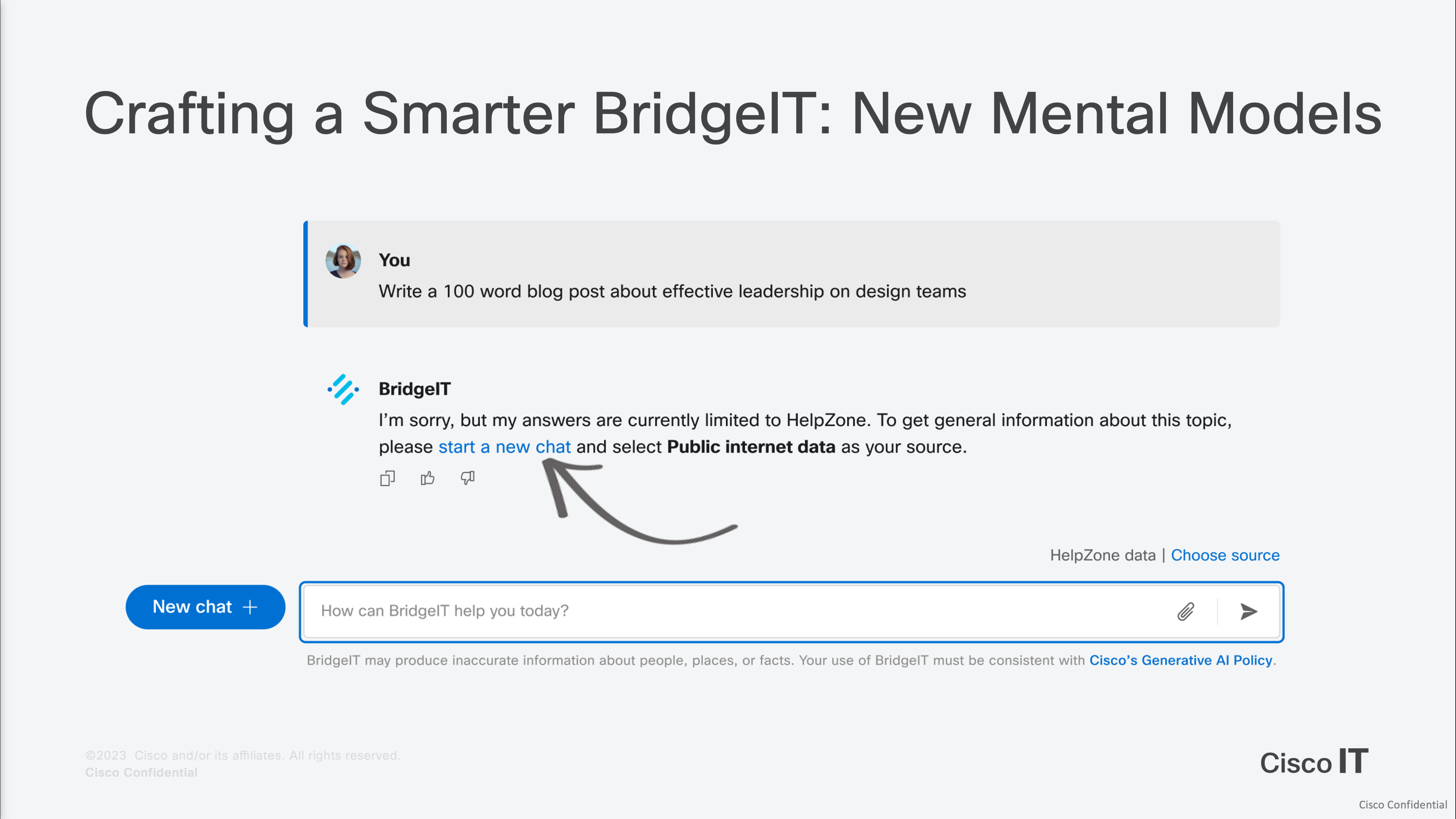
Designing new mental models for GenAI at work
Employees brought expectations from tools like ChatGPT, but BridgeIT worked differently:
- Internal vs. public data could not be mixed
- Not all sources were available to every user
- AI capabilities had to be learned through use, not documentation
The challenge was to help users learn while working, without overwhelming them.
Process
Define the BridgeIT vision
- I defined BridgeIT as a single, unified AI assistant for employees, focused on high priority IT tasks and real workflows. The goal was not to add AI broadly, but to design clear user flows and conversation patterns where AI could meaningfully assist.
- BridgeIT was intentionally designed, not just built. Design led the AI experience by shaping defaults, interaction patterns, and trust through use, not explanation.
- This work was grounded in user research, usability testing, and continuous feedback, ensuring the experience aligned with real employee needs and scaled with quality.
Build a central roadmap
I defined a clear roadmap with well scoped phases, outlining what could be delivered at each stage. I prioritized high impact, high feasibility internal data as initial test cases to validate value early.
Research Strategy
I worked closely with dedicated team of UX researchers through a comprehensive, multi-phase roadmap, personally overseeing the planning, execution, and observation of user interviews to transform product insights into a context-aware AI platform.
- Strategic Roadmap: Orchestrated four rounds of evaluative and generative testing, Phase 0 through Phase 3, to validate enterprise utility.
- Guided Execution: Led a research team in conducting "think-aloud" protocols and usability sessions with over 300 participants and 60 stakeholders.
- Observational Insights: Directed and observed user interviews to identify critical pain points and refine the AI's conversational flow.
- Data Prioritization: Managed Kano analysis and A/B testing to identify IT HelpZone and Cisco product knowledge as "table stakes".
- Business Impact: Validated a 90% accuracy rate and projected a 50% reduction in support case volume via self-help scenarios.
- UX Innovation: Directed the development of an "Intent Detector" to ensure the assistant integrated seamlessly into daily workflows.
Solution planning
Applying Cisco Internal Design System
I applied Cisco’s internal design system to rebrand BridgeIT, creating a familiar and trusted experience for users. By using consistent colors, typography, and components, I helped users feel comfortable and confident when using the tool.
Darkmode Implementation
I applied dark mode and delivered production ready designs to the dev team, working closely with QA to resolve UI defects and ensure a polished, consistent experience.
Why This Work Matters
BridgeIT is not just an AI product. It is an organizational change effort. This work demonstrates how design can lead deeply technical initiatives and how AI can be human centered without trying to appear human. It also shows that enterprise AI succeeds only when trust, clarity, and usability come first.
This project reflects how I approach complex systems by making the invisible understandable and the complicated feel simple.
Visual Design Execution
Phase 0 - Before & After
Before
After
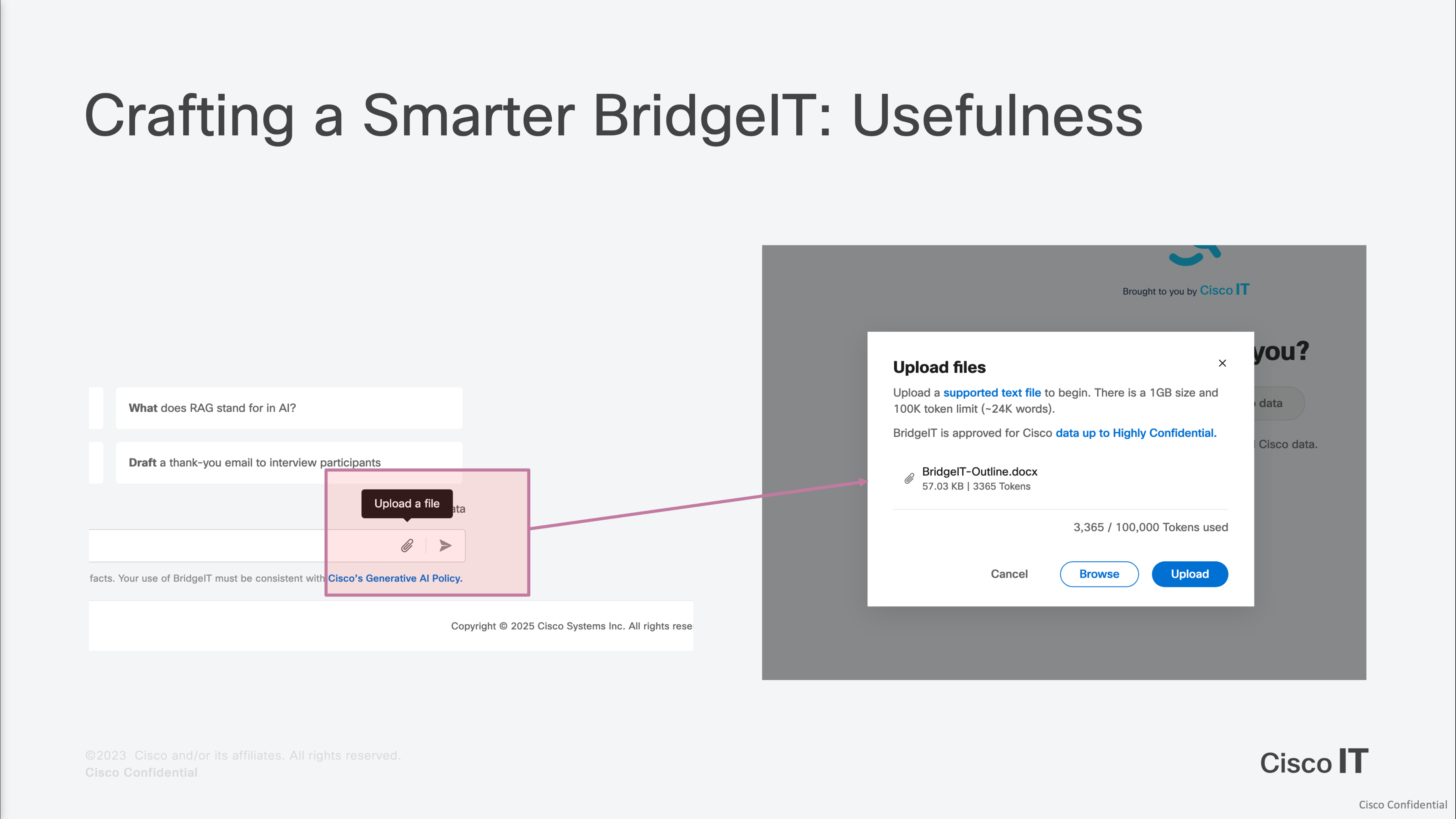
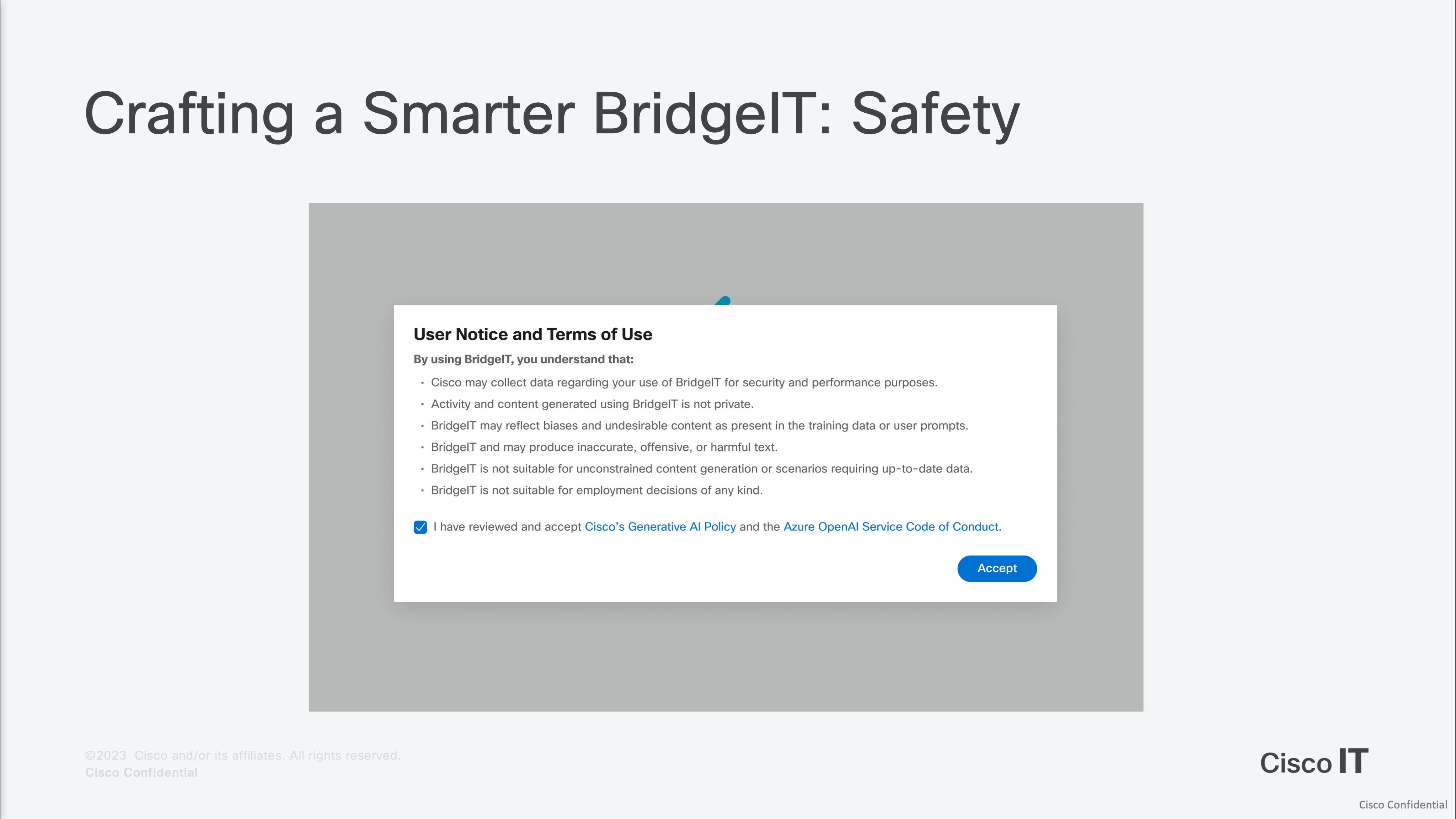
Phase 1 & Phase 2
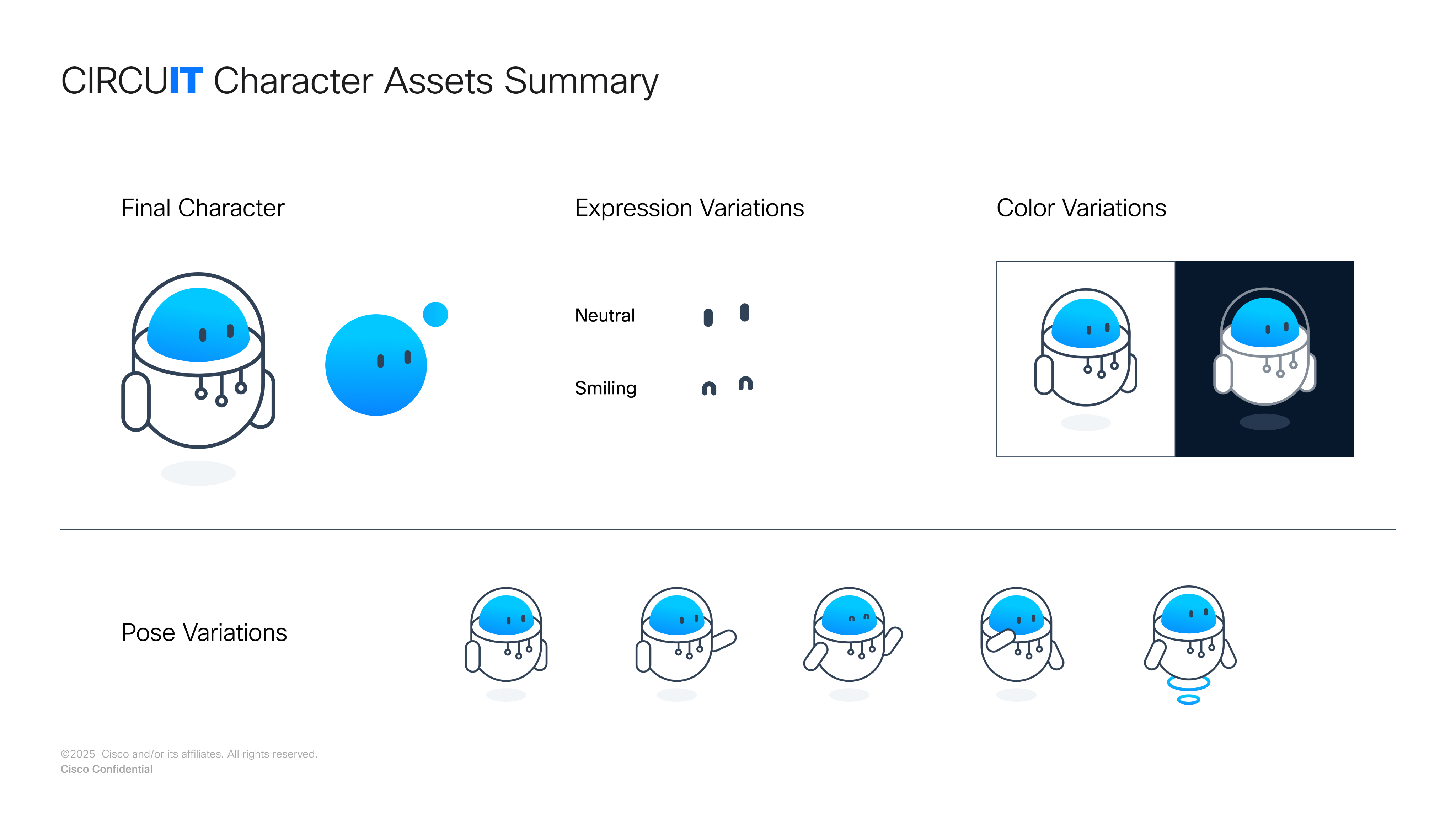
Phase 3: New Branding Identity from BridgeIT to CircuIT
Product Impact & Result
92K+
Users in Cisco
~96K+
Total interactions since launch
73%
Users report CircuIT increases productivity
5hrs
Average time saved per week by Cisco workforce
Executive Visibility and Adoption
BridgeIT was showcased at Cisco Beat by Fletcher Previn, SVP and CIO of Cisco, highlighting real employee adoption and productivity impact. Usage data demonstrated how employees were already using BridgeIT for high value tasks such as content creation, product research, and technical problem solving, reinforcing the importance of a trusted, design led enterprise AI experience.
Through a design-led approach, BridgeIT evolved from a developer-owned chat tool into a trusted, enterprise-grade AI assistant that:
- Increased usability and approachability for non-technical users
- Established a clear, consistent mental model for AI at Cisco
- Built confidence around safety, privacy, and data boundaries
- Created a scalable foundation for future capabilities such as:
- File upload and RAG
- Agent frameworks
- Workflow automation
- AI-assisted IT task completion
BridgeIT continues to evolve, but its foundation is rooted in a simple idea:
when AI feels easy, safe, and useful, people will actually use it.
sooyundesign@gmail.com
© Soo Yun Kim 2026 All Rights Reserved
BridgeIT
Designing a trusted, human centered, design led enterprise AI experience for employees
Worked from 2024 to early 2025BridgeIT Launched on January 2024, CircuIT Launched on June 2025
What is BridgeIT?
BridgeIT was originally launched as Cisco’s enterprise AI assistant, specifically designed to empower employees to work smarter, faster, and more confidently while operating within the company’s strict security, privacy, and compliance standards. At its inception, BridgeIT served as a safe internal alternative to public generative AI tools, ensuring that proprietary data remained protected. It quickly evolved from a simple interface into a design-led AI platform that integrates Cisco’s vast internal knowledge, systems, and complex workflows into a single, trusted assistant.
Rather than acting as just another instance of ChatGPT, BridgeIT was carefully positioned as a knowledgeable Cisco colleague that understands internal context, respects critical data boundaries, and supports employees directly within the flow of their daily work. This foundation of trust and deep integration eventually led to its strategic rebranding. Today, the platform continues its mission under the new name CircuIT, representing the next evolution of Cisco’s commitment to seamless, AI-driven productivity.
My Role: Lead Designer
I served as Principal Designer and Design Lead for BridgeIT, owning the end-to-end UX strategy.
My responsibilities included:
- Defining the product vision for BridgeIT as the AI assistant for Cisco employees
- Leading UX strategy across web, Webex, and future in-flow experiences
- Partnering closely with UX Research, Content Design, Engineering, Data, Legal, and Security
- Translating highly technical AI constraints into clear, usable, human-centered experiences
- Establishing design principles for trust, safety, and usability in GenAI products
- Shaping BridgeIT’s voice, tone, and character—approachable, knowledgeable, but never pretending to be human
- Using research and adoption data to prioritize features, defaults, and roadmap decisions
In practice, I acted as a bridge between design, engineering, and business, ensuring that complex AI systems felt intuitive, safe, and genuinely helpful to everyday employees.
The Challenge
BridgeIT Initial Design
This was the initial BridgeIT design, which did not follow Cisco’s Atmosphere design system and showed clear inconsistencies across the experience. Because the design was primarily owned by the development team, it lacked strong design alignment and consistency.

Usability issues
With only 31 percent adoption, users reported difficulty both in finding the tool and in using it effectively. In addition, the lack of Cisco data significantly limited its usefulness.
Technical constraints
The system was unable to merge multiple data sources, and it was unclear which teams were working with which vendors. At the same time, the project faced competition from other initiatives and very high expectations for success.
Size of the team
The core design and development team consisted of 15 people, most of whom were not allocated to the project at full capacity. Only a small portion of the team was well versed in AI.
Other challeges
Safety, ethics, and trust at enterprise scale
Unlike consumer AI tools, BridgeIT had to operate within:
- Strict data permissions and access controls
- PII, HR, legal, and restricted data policies
- Regional regulations and evolving AI governance
At the same time, users needed to feel safe, not just be told they were safe.
Designing new mental models for GenAI at work
Employees brought expectations from tools like ChatGPT, but BridgeIT worked differently:
- Internal vs. public data could not be mixed
- Not all sources were available to every user
- AI capabilities had to be learned through use, not documentation
The challenge was to help users learn while working, without overwhelming them.
Process
Define the BridgeIT vision
- I defined BridgeIT as a single, unified AI assistant for employees, focused on high priority IT tasks and real workflows. The goal was not to add AI broadly, but to design clear user flows and conversation patterns where AI could meaningfully assist.
- BridgeIT was intentionally designed, not just built. Design led the AI experience by shaping defaults, interaction patterns, and trust through use, not explanation.
- This work was grounded in user research, usability testing, and continuous feedback, ensuring the experience aligned with real employee needs and scaled with quality.
Build a central roadmap
I defined a clear roadmap with well scoped phases, outlining what could be delivered at each stage. I prioritized high impact, high feasibility internal data as initial test cases to validate value early.
Research Strategy
I worked closely with dedicated team of UX researchers through a comprehensive, multi-phase roadmap, personally overseeing the planning, execution, and observation of user interviews to transform product insights into a context-aware AI platform.
- Strategic Roadmap: Orchestrated four rounds of evaluative and generative testing, Phase 0 through Phase 3, to validate enterprise utility.
- Guided Execution: Led a research team in conducting "think-aloud" protocols and usability sessions with over 300 participants and 60 stakeholders.
- Observational Insights: Directed and observed user interviews to identify critical pain points and refine the AI's conversational flow.
- Data Prioritization: Managed Kano analysis and A/B testing to identify IT HelpZone and Cisco product knowledge as "table stakes".
- Business Impact: Validated a 90% accuracy rate and projected a 50% reduction in support case volume via self-help scenarios.
- UX Innovation: Directed the development of an "Intent Detector" to ensure the assistant integrated seamlessly into daily workflows.
Solution planning
Applying Cisco Internal Design System
I applied Cisco’s internal design system to rebrand BridgeIT, creating a familiar and trusted experience for users. By using consistent colors, typography, and components, I helped users feel comfortable and confident when using the tool.
Darkmode Implementation
I applied dark mode and delivered production ready designs to the dev team, working closely with QA to resolve UI defects and ensure a polished, consistent experience.
Why This Work Matters
BridgeIT is not just an AI product. It is an organizational change effort. This work demonstrates how design can lead deeply technical initiatives and how AI can be human centered without trying to appear human. It also shows that enterprise AI succeeds only when trust, clarity, and usability come first.
This project reflects how I approach complex systems by making the invisible understandable and the complicated feel simple.
Visual Design Execution
Phase 0 - Before & After
Before
After
Phase 1 & Phase 2
Phase 3: New Branding Identity from BridgeIT to CircuIT
Product Impact & Result
92K+
Users in Cisco
73%
Users report CircuIT increases productivity
~96K+
Total interactions since launch
5hrs
Average time saved per week by Cisco workforce
Executive Visibility and Adoption
BridgeIT was showcased at Cisco Beat by Fletcher Previn, SVP and CIO of Cisco, highlighting real employee adoption and productivity impact. Usage data demonstrated how employees were already using BridgeIT for high value tasks such as content creation, product research, and technical problem solving, reinforcing the importance of a trusted, design led enterprise AI experience.
Through a design-led approach, BridgeIT evolved from a developer-owned chat tool into a trusted, enterprise-grade AI assistant that:
- Increased usability and approachability for non-technical users
- Established a clear, consistent mental model for AI at Cisco
- Built confidence around safety, privacy, and data boundaries
- Created a scalable foundation for future capabilities such as:
- File upload and RAG
- Agent frameworks
- Workflow automation
- AI-assisted IT task completion
BridgeIT continues to evolve, but its foundation is rooted in a simple idea:
when AI feels easy, safe, and useful, people will actually use it.
sooyundesign@gmail.com
© Soo Yun Kim 2026 All Rights Reserved